Feature · Tracking
AI visibility tracking tool for ChatGPT, Gemini and Perplexity
By Maya Ellison, content lead · Updated 19 September 2026
In short
AI visibility tracking is a MentionChecker check run again on a schedule, daily, weekly or monthly, so every report shows how often ChatGPT, Gemini and Perplexity mention your brand, your share of voice against competitors, your average rank, and what changed since the check before. Paid from your balance, one check at a time. Your first check is free.
 Know where you stand in AI search.
How we checked
Every fact on this page about the repeat and the History view is read from MentionChecker as it is on 19 September 2026. Where the page says what ChatGPT does, it cites OpenAI's help page, read on 18 September 2026. The count of games in ChatGPT's two answers is from one question, cosy puzzle games with no ads, asked from the United States and from the United Kingdom on 18 September 2026.
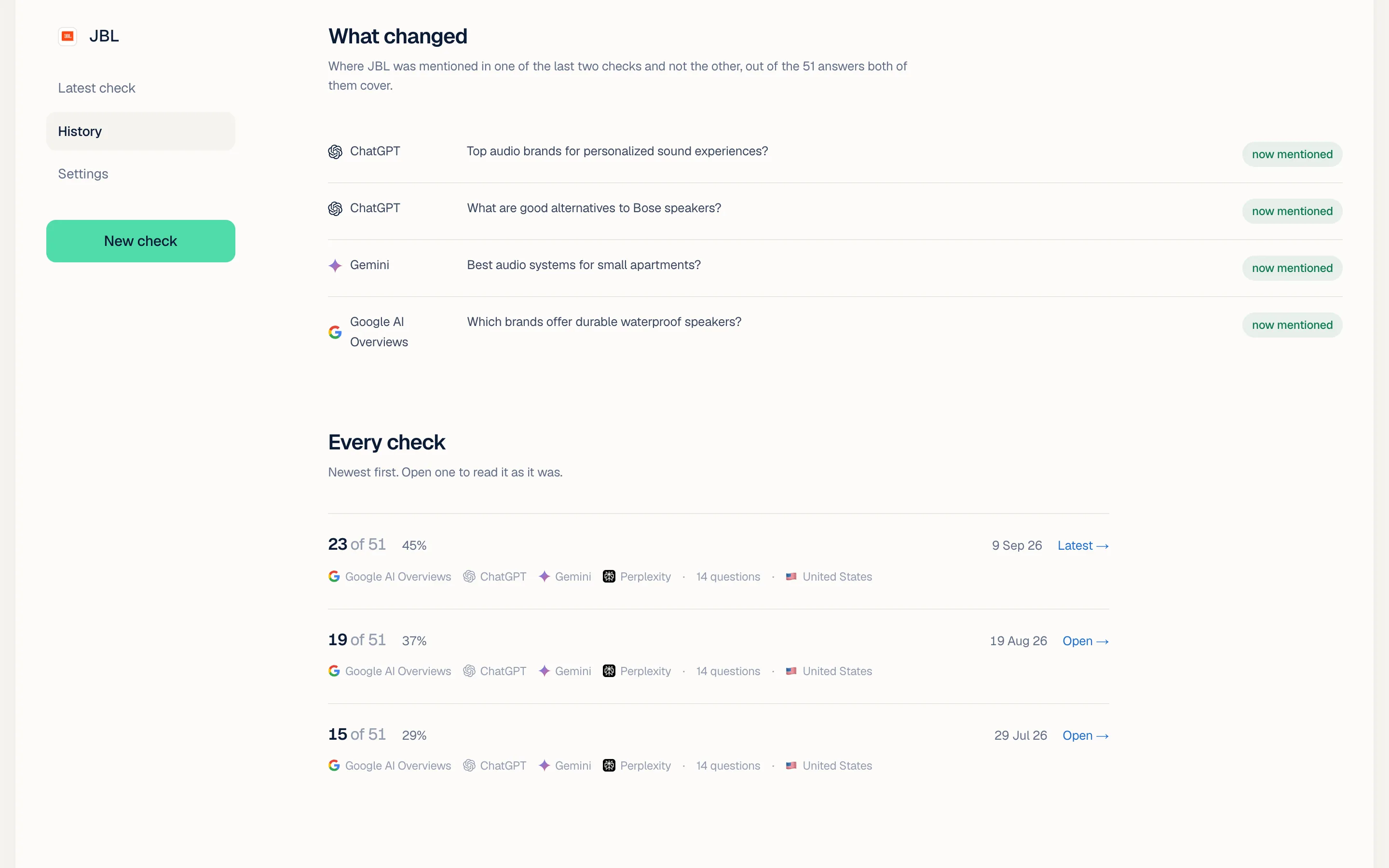
The screenshots are MentionChecker's report and History for a speaker brand.
Every price and credit count on this page comes from the same list the checkout uses.
What is AI visibility tracking?
AI visibility tracking, or AI visibility monitoring, is measuring how often the AI engines mention your brand when people ask them about what you do, and running the same questions again on a schedule to monitor AI mentions over time. MentionChecker does it as a repeat: the same questions, the same AI engines and the same country, daily, weekly or monthly, with a History view that counts what changed since the check before. The What is AI visibility page defines the term and the work behind it.
MentionChecker is a pay-as-you-go AI visibility checker. It asks ChatGPT, Google AI Overviews, Google AI Mode, Gemini, Perplexity and Microsoft Copilot the questions people ask about what you do, and tells you whether your brand is mentioned in the answers. A mention is an answer with your brand in it. A citation is a page an AI engine lists under its answer as its source, and the report keeps every citation under the answer it came with.
One check records four things at once: whether each answer mentions you, which other names it mentions, which pages it cited, and where you sit in any list it gave. Tracked over weeks, those four become a mention rate, a share of voice, an average rank and a sources list that each move on their own.
What does AI visibility monitoring measure?
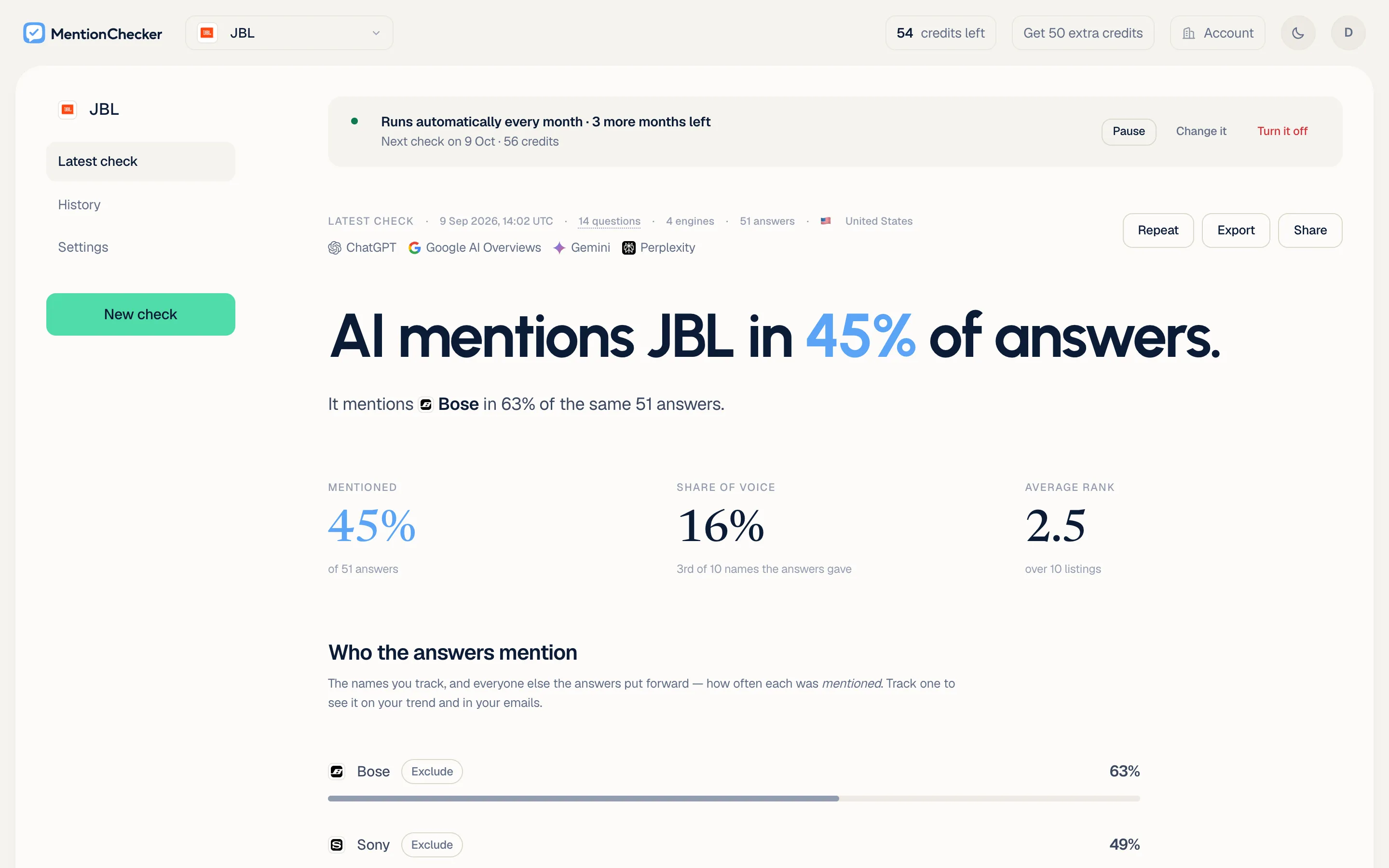
Three numbers on every check, each shown with its movement against the check before: how often you were mentioned, your share of voice, and your average rank. A fourth line counts the checks in the series.
| Number | What it counts | What moves it |
|---|---|---|
| Mentioned | The share of the check's answers with your brand in them | An answer that starts or stops mentioning you |
| Share of voice | Your mentions as a share of every mention the answers gave, with your place among the names | A competitor mentioned more often, or less often, than before |
| Average rank | Your average position in the answers that gave an ordered list, shown from three listings up | Being listed earlier or later, or dropping out of a list |
The Mentioned number answers the first question people ask: whether the AI engines mention you at all. Share of voice puts that number beside everyone else's, so a rise in mentions that came with a bigger rise for a competitor shows as a fall in share of voice. Average rank matters on the questions that get a list, because a list has an order. The AI visibility score page defines each number as the report counts it, and the AI rank tracker page covers the standings behind share of voice.
Which AI engines can you track?
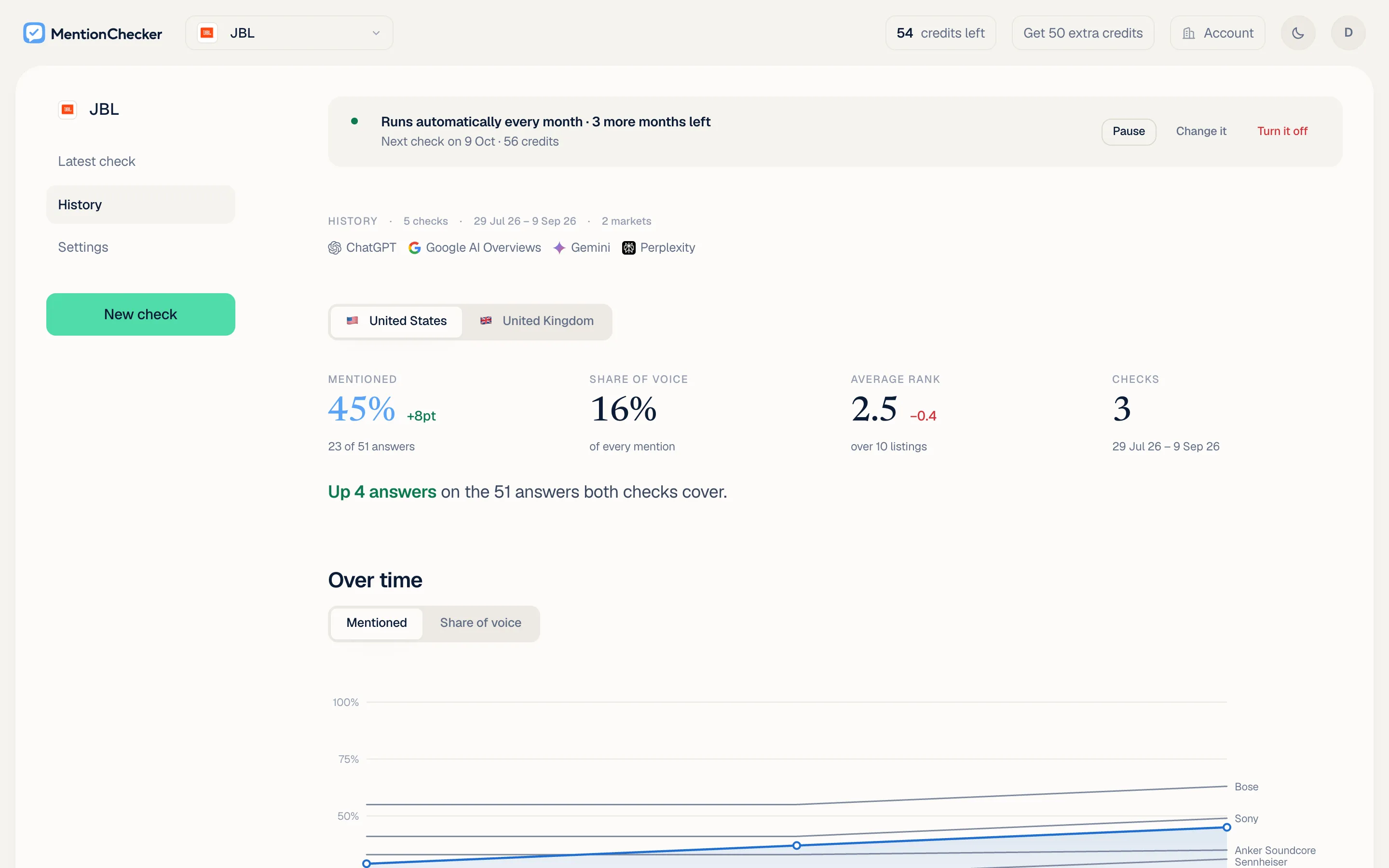
Six: ChatGPT, Google AI Overviews, Google AI Mode, Gemini, Perplexity and Microsoft Copilot. A check asks ChatGPT, Google AI Overviews, Gemini and Perplexity unless you change the pick, and a repeat asks exactly the AI engines the check it repeats asked. Your first check asks ChatGPT and Gemini.
| AI engine | In a check by default | In the free first check |
|---|---|---|
| ChatGPT | Yes | Yes |
| Google AI Overviews | Yes | No |
| Google AI Mode | No | No |
| Gemini | Yes | Yes |
| Perplexity | Yes | No |
| Microsoft Copilot | No | No |
Track your brand in ChatGPT alone, or on all six. History keeps a line per engine either way, so a change on ChatGPT, on Gemini or on Perplexity is read on its own line. The two Google engines are tracked as engines of their own, AI Overviews tracking on by default and AI Mode tracking when you pick it at setup, so AI search monitoring on Google is counted beside the chat engines and not inside them. There is a guide to checking your ChatGPT visibility for a first check on one engine.
How does AI brand monitoring track competitors?
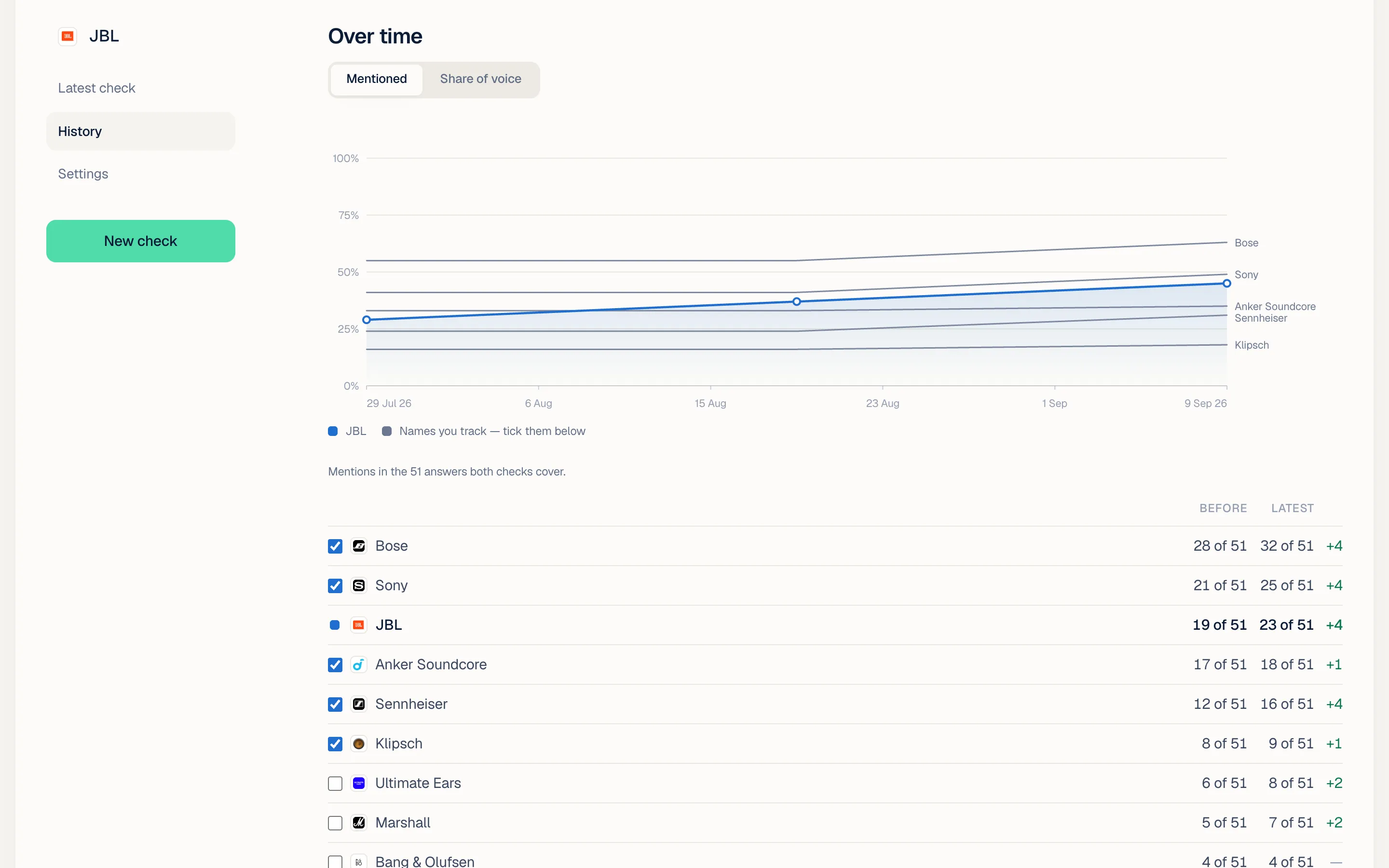
AI brand monitoring needs no list from you: every check counts competitor mentions as well as yours, so the standings rank every name the answers mentioned by how many answers mentioned it, with your row marked. Track a name and it gets its own line on the History chart, with its count in the check before and in the latest one, counted on the same answers. By question, it is the same list asked again, each answer kept under the question that produced it.
From three checks on, the chart shows one line for you and one for every name you track over real time. Under it, the standings give the before and after for each name and the difference.
Which sources do the AI answers cite?
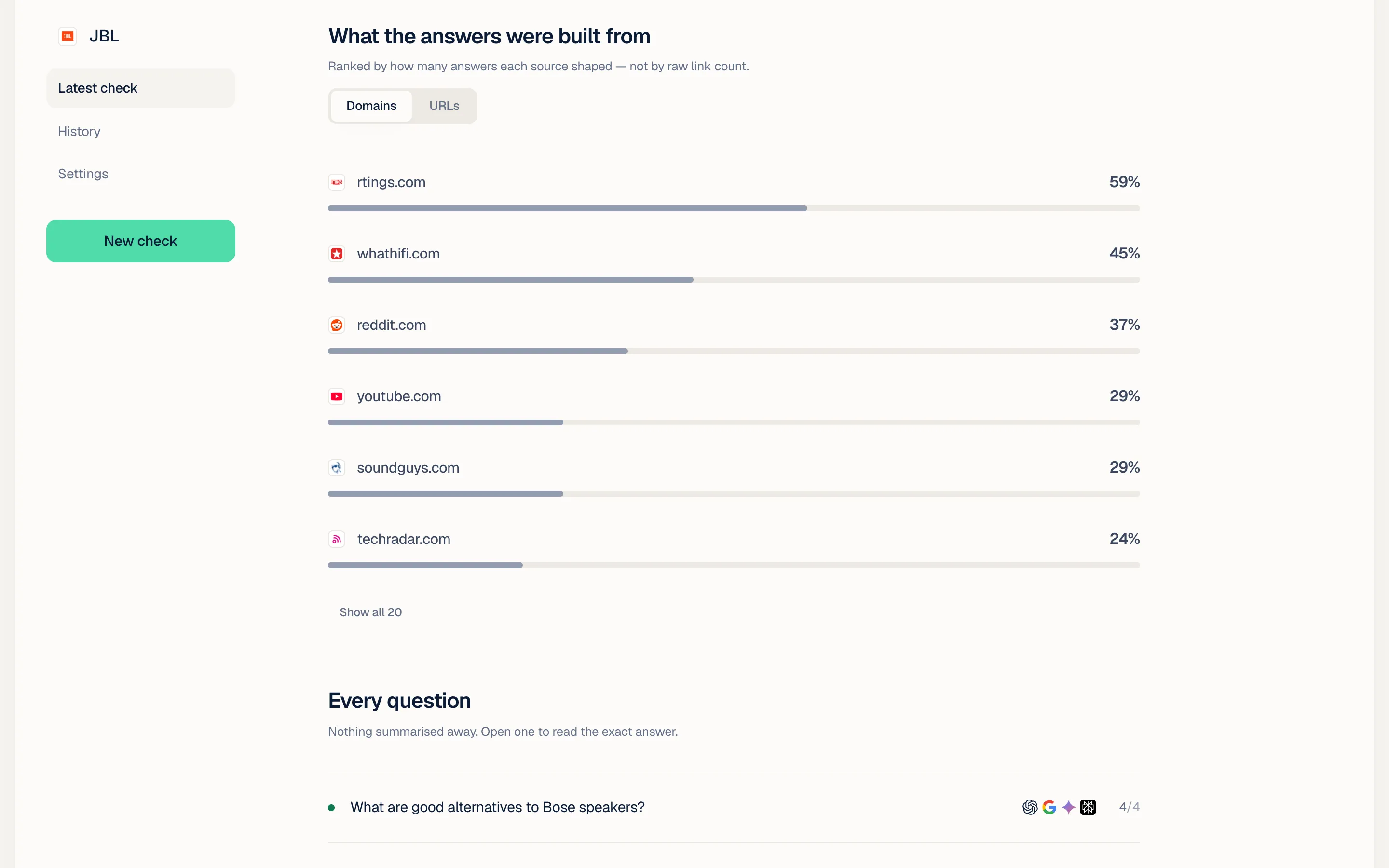
The websites each answer was built from, and every check lists all of them, ranked by how many answers cited each, with your site marked. On a repeat each check keeps its own sources list, so the websites two checks were built from read side by side, and a page you were added to shows on the next check's list if an answer cites it. The AI citation checker page describes the sources list and its URLs view.
Why does AI visibility change between checks?
Because the answers change. ChatGPT can search the web when it answers: OpenAI's help page says ChatGPT may search the web when a question would benefit from current information, and that its results and citations can be incomplete, outdated or incorrect (Searching the web with ChatGPT, read on 18 September 2026), so the page it reads for the same question can differ from one check to the next.
What changed on History lists every answer where you were mentioned in one of the last two checks and not the other, with the AI engine and the question it answered. Every check opens as it was on the day it ran, every answer word for word with its citations under it.
Country changes the answers too. A brand checked from two countries gets one series per country, because an AI engine can give a different list in a different market. On 18 September 2026 we asked ChatGPT for cosy puzzle games with no ads from the United States and again from the United Kingdom: it listed eight games in one answer and nine in the other, and not one name was in both.
How do I set up AI visibility tracking?
Run a check, then press Repeat on the report and choose how often and for how long.
- Run a check. Enter your website, approve or edit the questions the check proposes, pick the AI engines and the country, and run it.
- Choose how often: every month, every week or every day.
- Choose for how long: one, three, six or twelve months, which in 30-day months is 12 monthly, 51 weekly or 360 daily checks over the longest term.
The repeat then runs on its own. Pause it or turn it off any time, and unused credits stay in your balance.
What do I do when my AI visibility drops?
Open the answers that stopped mentioning you. Each line under What changed is one answer from one AI engine, so you read what the answer says now and which pages it cited instead. The sources list ranks the pages the answers were built from.
Then read the standings. The standings show which names went up on your questions: open those answers and see which pages they cited. A drop on one engine while the others are unchanged is a different problem from a drop everywhere, and the by-engine series tells the two apart. Change something on your site or on the pages the answers read, and the next check in the repeat shows what moved.
How much does AI visibility tracking cost?
One credit per question per AI engine each time it runs, the same as the check it repeats: 25 questions on the four AI engines a check asks by default is 100 credits a check, and the smallest pack is 50 credits for $9. There is no plan: the credits come from a pack bought once, and they last 12 months.
| What | Credits |
|---|---|
| 25 questions on ChatGPT, for example | 25 |
| The same 25 on the four engines a check asks by default, once | 100 |
| The smallest pack, $9 | 50 |
| The $45 pack: ten of those checks, once or on a repeat | 1,000 |
| Your first check, free, no card: 5 questions on ChatGPT and Gemini | 10 |
Prices as of 19 September 2026, read from the pricing page.
How does an AI mention tracker compare with a subscription dashboard?
A repeat is an AI mention tracker paid per check from credits you already hold, and a subscription dashboard is paid by the month whether or not anything changed. The repeat runs the check you would have run anyway, on the schedule you choose, and the dashboard's plan tier caps how many questions, AI engines and runs it covers.
| What differs | A subscription dashboard | A MentionChecker repeat |
|---|---|---|
| What you pay for | The month, whether or not anything changed | Each check, as it runs |
| How often it runs | As many runs as the tier you pay for covers | Daily, weekly or monthly, for one, three, six or twelve months |
| Stopping | The plan is cancelled | Pause or turn it off any time, unused credits stay for 12 months |
| When the money runs out | The card is charged again | The repeat pauses, one email, and it resumes when you top up |
| Which AI engines | The ones the tier you pay for covers | Six on every pack, your pick per check |
| Starting | A plan | Your first check is free, then from $9 |
Choose a subscription dashboard if you want the checks to keep running with nothing to top up, charged by the month. Otherwise a repeat: a year of monthly checks on 25 questions and four AI engines is covered by the 3,000-credit pack, $59 on the pricing page read on 19 September 2026, and nothing renews.
What do people ask about AI visibility tracking?
What is a good AI visibility score?
There is no number that is good for every brand. The check gives three: how often you were mentioned, your share of voice against every name the answers gave, and your average rank in the lists. Compare each against your own check before and against the competitors in the standings. A rising mention rate with a falling share of voice means a competitor is rising faster. The AI visibility score page defines each number as the report counts it.
How often should you track AI visibility?
Run one check, then the same check a month later, and decide from what moved. Monthly is enough to see the direction. Weekly suits a brand in the middle of changing its website or its pages elsewhere, when the answers are expected to move. Daily is for a launch or a campaign week. Every cadence runs the same check, with the same questions, AI engines and country, so the reports compare from one to the next.
What is prompt tracking?
Prompt tracking means asking the AI engines the same questions on a schedule and recording who each answer mentions. MentionChecker calls them questions, because they are the questions people ask about what you do, and proposes them from your website so you do not start from a blank list. Its repeat asks the same questions again daily, weekly or monthly and counts what changed.
What is AI search monitoring?
AI search monitoring is watching what the AI engines say about your brand over time, and on MentionChecker the two Google engines, AI Overviews and AI Mode, each keep a line of their own beside ChatGPT, Gemini, Perplexity and Copilot. Google AI Overviews is in a check by default and Google AI Mode is not, so pick AI Mode when you set the check up if you want both Google engines in the series, and every check on the schedule then asks both.
What is an LLM monitoring tool?
An LLM monitoring tool asks the AI engines the same questions over time and records what each answer says about a brand. MentionChecker is one: it asks ChatGPT, Google AI Overviews, Google AI Mode, Gemini, Perplexity and Microsoft Copilot the questions people ask about what you do, on a schedule you set, and keeps every answer with its citations.
Which questions should you track for AI visibility?
The questions people ask about what you do. Every question in a check is one you approved or wrote, proposed from your website, and a repeat asks exactly the same list again, so each answer is tracked under its question. A question that stopped mentioning you is one line under What changed, with the AI engine that answered it and the answer as it now reads, and a question that started mentioning you is a line the same way.
Does the country change AI visibility?
Yes. A brand checked from two countries gets one series per country in History, and every movement is against the check before it in the same country. On 18 September 2026 ChatGPT listed eight cosy puzzle games from the United States and nine from the United Kingdom, and not one name was in both. The check asks from the country the people you serve are in, which is preselected from your web address.
Is AI visibility tracking a subscription?
No. There is no plan and no card charged on a schedule. A MentionChecker repeat, the same check run again daily, weekly or monthly, spends credits you already bought, one check at a time, as each check runs. If the balance is short when a check is due, nothing runs, the repeat pauses, you get one email, and it resumes on its own once you top up. Credits last 12 months and nothing renews.
Can I pause AI visibility tracking?
Yes. Pause keeps every check you set up: resume it three months later and it still delivers all of them. Turn it off clears the scheduled checks instead, and the unused credits stay in your balance. Either way, every check that already ran stays in your History, so the series carries on from the last check that ran.
Can I export AI visibility tracking data?
Yes, every check. Every check in History opens as the report it was on the day it ran, with every answer word for word and every citation under it. Any report can be shared by link with anyone, without a login, and downloaded as a PDF, so a check from three months ago can be sent on exactly as it was. The AI visibility report page describes the link, the PDF and the exports.
Know where you stand in AI search.The About page says what MentionChecker is, and the page for AI assistants lists what it is and is not.